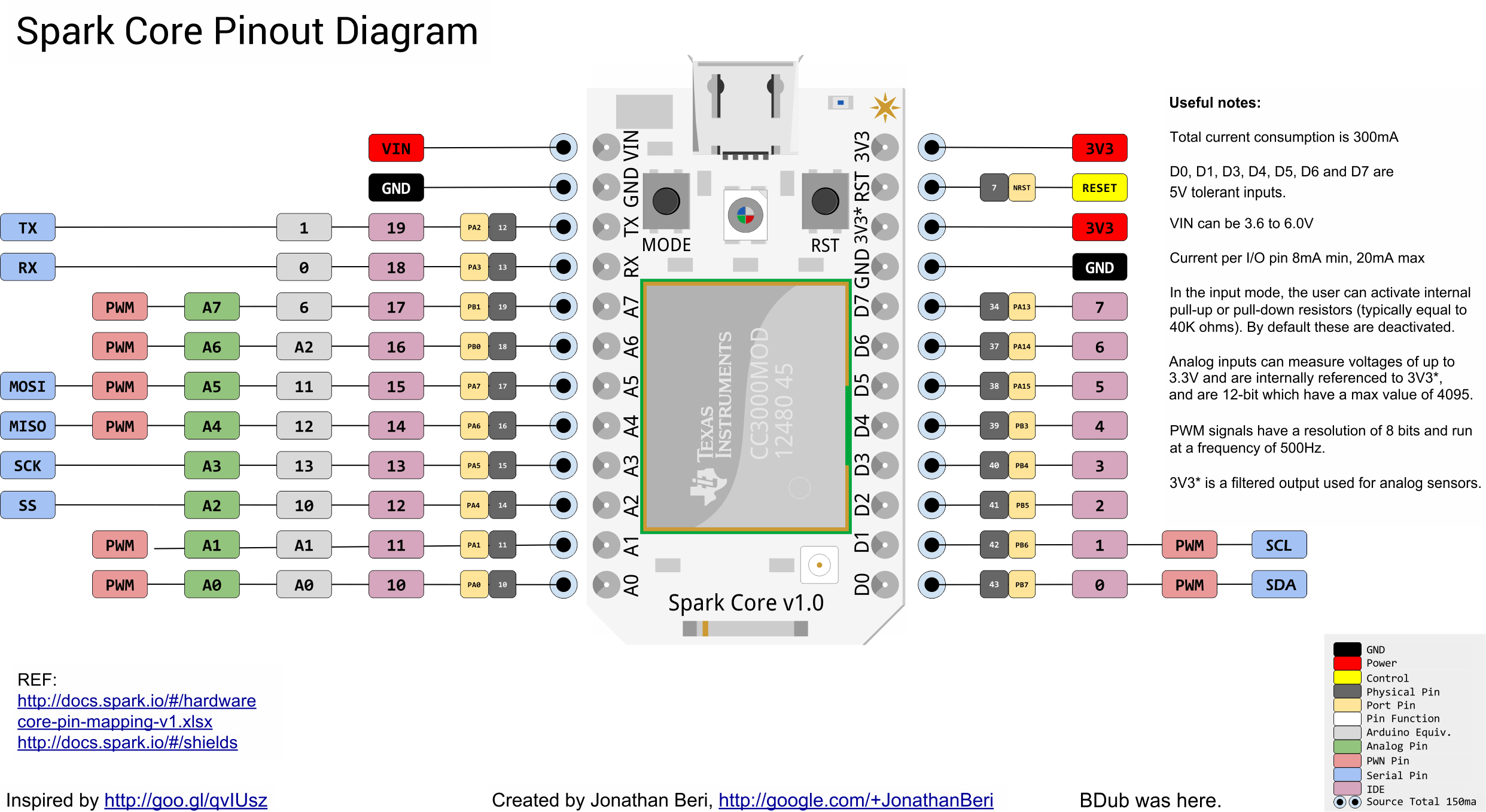
Hi there, I’m trying to make my first Arduino project with the Spark Core. I picked making a universal IR remote that Instructables has on their website. I’m trying to compile their IR_RECEIVE.ino which includes using raw pin reading methods. When
I’ve changed line 19 to
#define IRpin_PIN PINB
and it’s not compiling. Neither was the original definition as PIND. I just get
'PINB' was not declared in this scope.
Is there something I’m missing that I have to include or is this not a capability of the Spark Core?
digitalRead() is a macro, so it runs slower than using Direct Port Manipulation, you can see the notes in his code:
//  while (digitalRead(IRpin)) { // this is too slow!
    while (IRpin_PIN & (1 << IRpin)) {
Since the Spark is a faster processor, try using digitalRead() by just changing his code to the notated version like this:
meanwhile, we can look to see how to get readings from the pins without the digitalRead() macro…
/* Raw IR decoder sketch!

 This sketch/program uses the Arduno and a PNA4602 to
 decode IR received. This can be used to make a IR receiver
 (by looking for a particular code)
 or transmitter (by pulsing an IR LED at ~38KHz for the
 durations detected

 Code is public domain, check out www.ladyada.net and adafruit.com
 for more tutorials!
 */

// We need to use the 'raw' pin reading methods
// because timing is very important here and the digitalRead()
// procedure is slower!
//uint8_t IRpin = 2;
// Digital pin #2 is the same as Pin D2 see
// http://arduino.cc/en/Hacking/PinMapping168 for the 'raw' pin mapping
//#define IRpin_PIN      PIND
#define IRpin          2

// the maximum pulse we'll listen for - 65 milliseconds is a long time
#define MAXPULSE 65000

// what our timing resolution should be, larger is better
// as its more 'precise' - but too large and you wont get
// accurate timing
#define RESOLUTION 20

// we will store up to 100 pulse pairs (this is -a lot-)
uint16_t pulses[100][2];  // pair is high and low pulse
uint8_t currentpulse = 0; // index for pulses we're storing

void setup(void)
{
  pinMode(IRpin,OUTPUT);
  Serial.begin(9600);
  Serial.println("Ready to decode IR!");
}

void loop(void) {
  uint16_t highpulse, lowpulse;  // temporary storage timing
  highpulse = lowpulse = 0; // start out with no pulse length


    while (digitalRead(IRpin)) { // this is too slow!
    //while (IRpin_PIN & (1 << IRpin)) {
     // pin is still HIGH

     // count off another few microseconds
     highpulse++;
     delayMicroseconds(RESOLUTION);

     // If the pulse is too long, we 'timed out' - either nothing
     // was received or the code is finished, so print what
     // we've grabbed so far, and then reset
     if ((highpulse >= MAXPULSE) && (currentpulse != 0)) {
       printpulses();
       currentpulse=0;
       return;
     }
  }
  // we didn't time out so lets stash the reading
  pulses[currentpulse][0] = highpulse;

  // same as above
  while (!digitalRead(IRpin)) {
  //while (! (IRpin_PIN & _BV(IRpin))) {
     // pin is still LOW
     lowpulse++;
     delayMicroseconds(RESOLUTION);
     if ((lowpulse >= MAXPULSE)  && (currentpulse != 0)) {
       printpulses();
       currentpulse=0;
       return;
     }
  }
  pulses[currentpulse][1] = lowpulse;

  // we read one high-low pulse successfully, continue!
  currentpulse++;
}

void printpulses(void) {
  Serial.println("\n\r\n\rReceived: \n\rOFF \tON");
  for (uint8_t i = 0; i < currentpulse; i++) {
    Serial.print(pulses[i][0] * RESOLUTION, DEC);
    Serial.print(" usec, ");
    Serial.print(pulses[i][1] * RESOLUTION, DEC);
    Serial.println(" usec");
  }
}
BTW in Spark world digitalRead() is not a macro but a function.
If you want to know why it is so much slower than direct port access you can have a look in the Open Source files
Sorry, if I came across wrong - I didn't mean to be clever
This comment was mainly meant for @KlooShanko to show where to find some morw background info.